. Learn how quantum computing threatens RSA/ECC and how new lattice-based encryption will secure our digital future in 2026.)
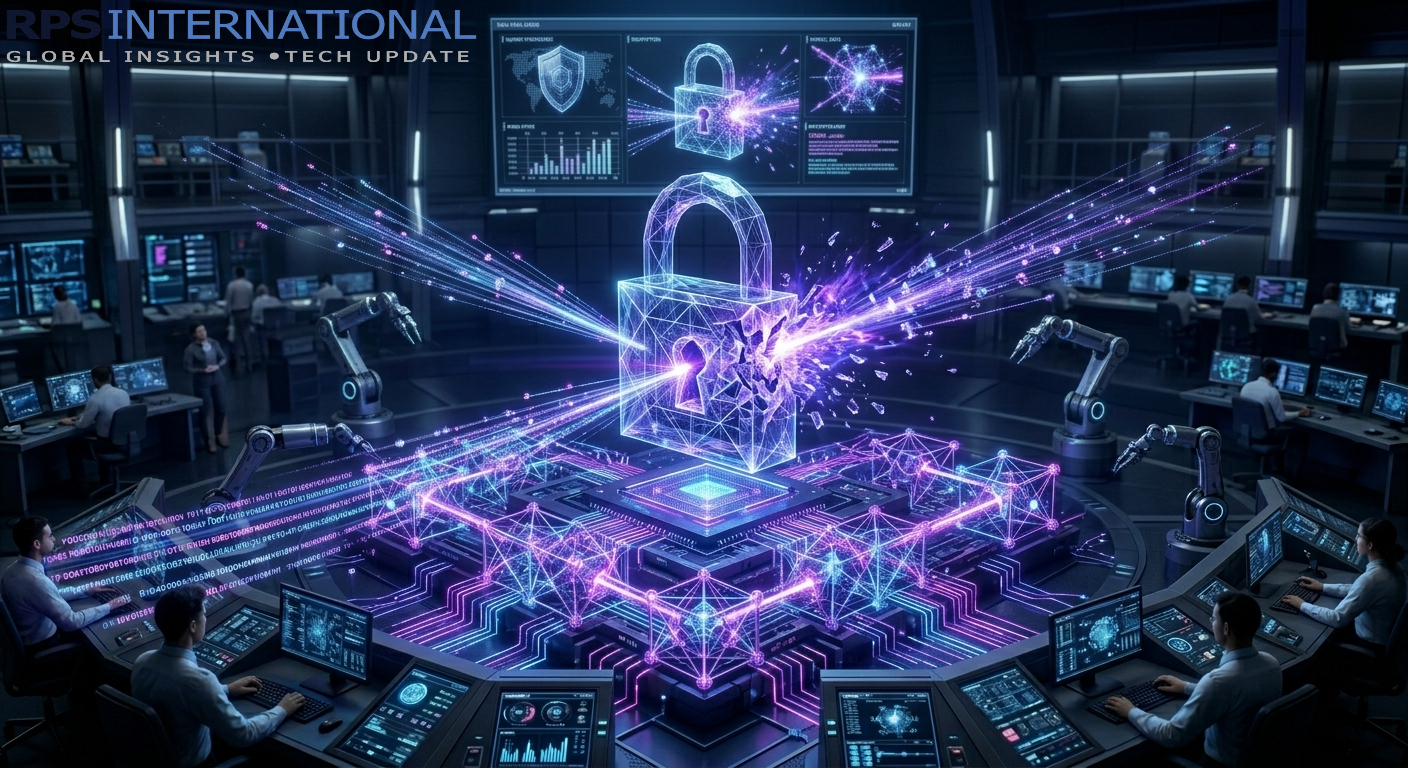
The Future of Encryption:
In the Age of Quantum Computing
The Pillars of Quantum Resilience
Lattice-Based Math
Replacing prime factorization with high-dimensional geometric problems that even quantum computers cannot solve efficiently.
QKD Networks
Quantum Key Distribution uses the laws of physics to detect eavesdropping instantly by observing changes in photon states.
Crypto-Agility
The ability for systems to automatically switch encryption algorithms as soon as a specific method is flagged as vulnerable.
Why Classical Encryption is Dying
Our current security infrastructure relies on Shor’s Algorithm remaining a theoretical threat. However, quantum hardware has advanced to the point where breaking RSA-2048 or ECC is no longer a matter of “if,” but “when.”
The most pressing danger today is “Harvest Now, Decrypt Later” (HNDL). Threat actors are stealing encrypted data now, waiting for future quantum computers to unlock it years later.
2026 Implementation Stat:
Over 60% of Fortune 500 companies have completed their initial transition to NIST-approved PQC algorithms like CRYSTALS-Kyber.
Quantum Threat Matrix
Quantum computers utilize superposition and entanglement to bypass the computational barriers of binary logic:
- Symmetric Keys (AES): Weakened by Grover’s Algorithm (needs longer keys).
- Asymmetric Keys (RSA/ECC): Completely broken by Shor’s Algorithm.
- Digital Signatures: Vulnerable to forgery via quantum computation.
- Hashing Functions: Relatively resistant but require higher bit-depth for safety.
The NIST Standardization Era
The global shift toward quantum safety is being led by the National Institute of Standards and Technology (NIST). In 2026, we have moved past the testing phase into full-scale deployment of standardized PQC algorithms. The primary focus has been on Lattice-based cryptography, which involves finding the shortest vector in a complex, multi-dimensional grid—a problem that remains computationally “hard” for both classical and quantum systems.
However, the migration is complex. PQC keys are significantly larger than their classical predecessors, leading to increased bandwidth consumption and latency. This has necessitated a redesign of basic internet protocols like TLS 1.4 and SSH to accommodate these heavy-duty cryptographic payloads without breaking legacy hardware.
Beyond math, we are seeing the rise of the Quantum Internet. By using entanglement to transmit information, we can achieve “unhackable” communication. If an interceptor attempts to measure the quantum state of a transmitted key, the state collapses, notifying both the sender and receiver of the breach instantly. This is the ultimate end-game for digital privacy.
Encryption Standards: Pre vs. Post Quantum
| Algorithm Type | Current Standard (Pre) | Quantum Standard (Post) |
|---|---|---|
| Key Exchange | Diffie-Hellman / RSA | ML-KEM (Kyber) |
| Digital Signatures | ECDSA / RSA-PSS | ML-DSA (Dilithium) |
| Encryption Hardware | Standard CPUs/TPMs | Quantum-Safe Enclaves |
| Security Level | Computational Hardness | Lattice/Physics-based Hardness |
Prepare for the Quantum Future
The data you protect today must remain secure for the next 50 years. Start your quantum-readiness audit before the classical walls fall.