
Advanced Materials:
Building Next-Gen Electronics
The 2026 Innovation Stack
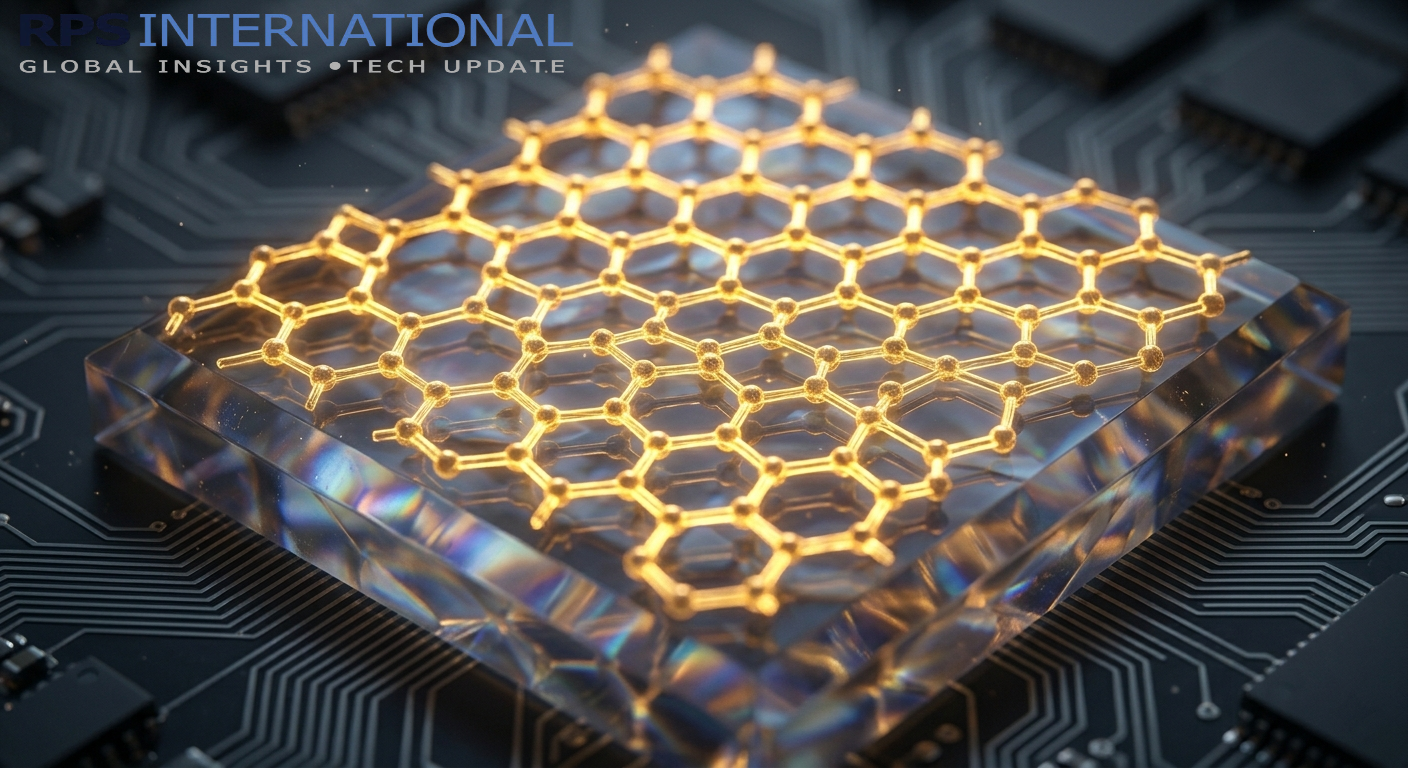
TMDs (2D Materials)
Transition Metal Dichalcogenides like MoS2 allow for transistors only 3 atoms thick, drastically reducing power leakage in mobile processors.
Gallium Nitride (GaN)
Replacing silicon in power electronics to enable ultra-fast chargers and highly efficient EV inverters that operate at much higher temperatures.
Perovskite Crystals
A game-changer for flexible electronics and next-gen displays, offering superior light-to-electricity conversion and vibrant color purity.
The End of Moore’s Law?
As transistors approach the size of a single atom, quantum tunneling makes traditional silicon-based logic unreliable. The solution in 2026 is Heterogeneous Integration—stacking different materials like Graphene and Germanium on top of silicon to create “More than Moore” performance gains.
These materials don’t just shrink the chip; they introduce new physical properties, such as Superconductivity at higher temperatures and Ballistic Transport, where electrons move without resistance.
2026 Production Stat:
Global investment in Graphene-on-Insulator (GoI) wafer production has increased by 210% this year to support AI data centers.
Neuromorphic Materials
The biggest breakthrough in 2026 is the use of Memristors—materials that can “remember” the amount of charge that has passed through them:
- Synaptic Mimicry: These materials behave like human neurons, allowing AI to run locally on devices with 1/1000th the power.
- Non-Volatile Logic: Computation and memory happen in the same place, eliminating the “memory wall” bottleneck.
- Organic Semiconductors: Flexible, biocompatible materials for wearable health tech.
- Self-Healing Conductors: Polymers that automatically repair microscopic cracks in circuitry.
Chiplets and the “Lego” Approach
In 2026, the “monolithic” chip is a thing of the past. Instead, engineers are using Advanced Packaging to combine “chiplets” made from different specialized materials. For example, a single processor may have a core made of advanced silicon, an AI accelerator made of a 2D TMD material, and a power management unit made of Gallium Nitride. All of these are connected via high-speed Optical Interconnects that use light instead of electricity to move data.
This modular approach allows for much higher yields and lower costs, as only the most critical parts of the chip need to be made with the most expensive new materials. It also enables Edge AI—giving smartphones the power of a 2024-era supercomputer while maintaining a 48-hour battery life.
Material Evolution: The Silicon Transition
| Property | Traditional Silicon | 2026 Advanced Materials |
|---|---|---|
| Atomic Thickness | ~50-100 Atoms (FinFET) | 1-3 Atoms (2D Lattice) |
| Electron Mobility | Moderate (Heat Generation) | Ultra-High (Ballistic Flow) |
| Thermal Resistance | Low (Requires cooling) | Extreme (Wide Bandgap) |
| Flexibility | Rigid / Brittle | Foldable / Stretchable |
Hardware is the New Software
The next leap in digital capability won’t come from code—it will come from the atoms we use to build it. Explore the future of material engineering.