
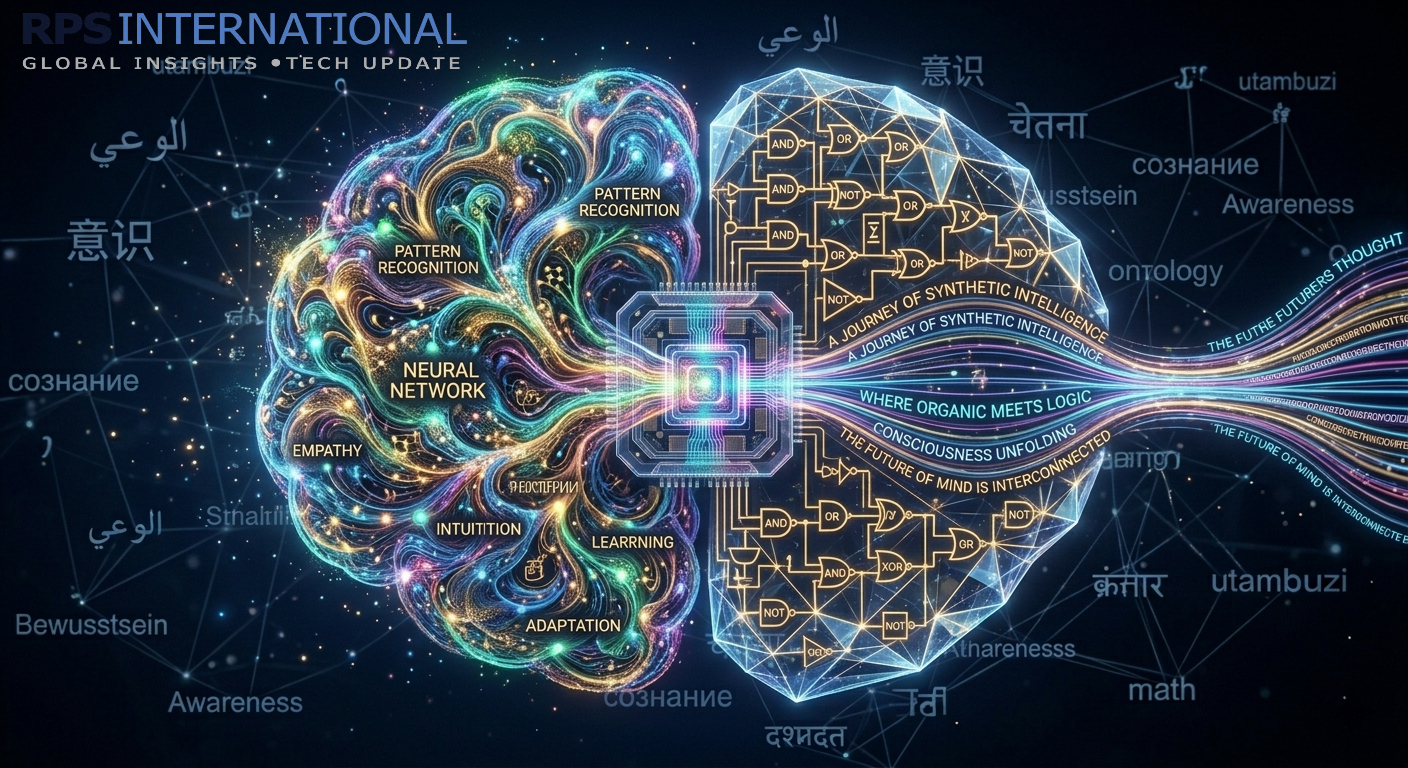
Neuro-Symbolic AI:
The Logic of Artificial General Intelligence
The Dual-Process Model
System 1: Neural Perception
The “Fast” brain. Neural networks handle raw data—images, sounds, and text—using massive statistical sets to identify patterns and “intuitions” about the world.
System 2: Symbolic Logic
The “Slow” brain. Symbolic engines apply formal rules, physics, and mathematical logic to verify the neural output, ensuring responses are grounded in reality.
Verification Loop
A continuous “Cognitive Watchdog” that checks for hallucinations. If the neural prediction violates a known logical rule, the system re-runs the process until it aligns.
Why Scale Alone Failed
By late 2025, the “Compositional Cliff” became the primary barrier for LLMs. While models could write poetry, they struggled with basic multi-step planning or novel geometry problems—tasks that require abstraction rather than imitation.
Neuro-symbolic architectures solve this by embedding “World Models”—hard-coded rules about gravity, causality, and ethics—directly into the learning process. This makes AI 100x more energy-efficient because it doesn’t have to “guess” the laws of physics; it already knows them.
2026 Performance Stat:
In the ARC-AGI benchmark, hybrid neuro-symbolic systems achieved a 95% success rate on novel logic puzzles, compared to just 34% for traditional neural models.
The Path to Generalization
To reach AGI, neuro-symbolic systems are tackling three key challenges in 2026:
- Continuous Learning: Learning new rules from conversation without “catastrophic forgetting” of old knowledge.
- Explainable Diagnostics: In healthcare, symbolic logic provides a traceable “audit trail” for every AI diagnosis, ensuring clinical safety.
- Robotic Planning: VLAs (Vision-Language-Action models) use symbolic “sandboxes” to test physical maneuvers before the robot moves a finger.
- Differentiable Logic: Converting rigid symbols into mathematical gradients so the entire system can be optimized simultaneously.
From Predictors to Agents
The transition to Agentic AI in 2026 is powered entirely by neuro-symbolic reasoning. A purely neural agent might “hallucinate” a payment to the wrong vendor or book a flight for the wrong day because it “felt” like a probable next step. A neuro-symbolic agent, however, executes its actions within a Symbolic Sandbox—a state-aware environment where it verifies that its plan matches the user’s intent and external constraints (like bank balances or calendar availability) before taking action.
This is the “I2L” (Intuition-to-Logic) breakthrough. Neural intuition prunes the infinite search space of possibilities, while symbolic execution confirms the one correct path. This architecture isn’t just a tech upgrade; it is the fundamental requirement for delegating high-stakes tasks to AI in 2026.
Deep Learning vs. Neuro-Symbolic AI
| Metric | Pure Neural (LLMs) | Neuro-Symbolic (2026) |
|---|---|---|
| Foundation | Statistical Probabilities | Probabilities + Formal Logic |
| Trustworthiness | Low (Hallucination Prone) | High (Rule-Verified) |
| Data Efficiency | Requires Trillions of Tokens | Learns from Rules & Small Data |
| AGI Status | “Imitation” of Intelligence | “Grounded” World Understanding |
Join the Reasoning Revolution
The road to AGI is paved with logic. Explore how Neuro-Symbolic AI can provide the auditability, safety, and reasoning your organization needs in the agentic era.