
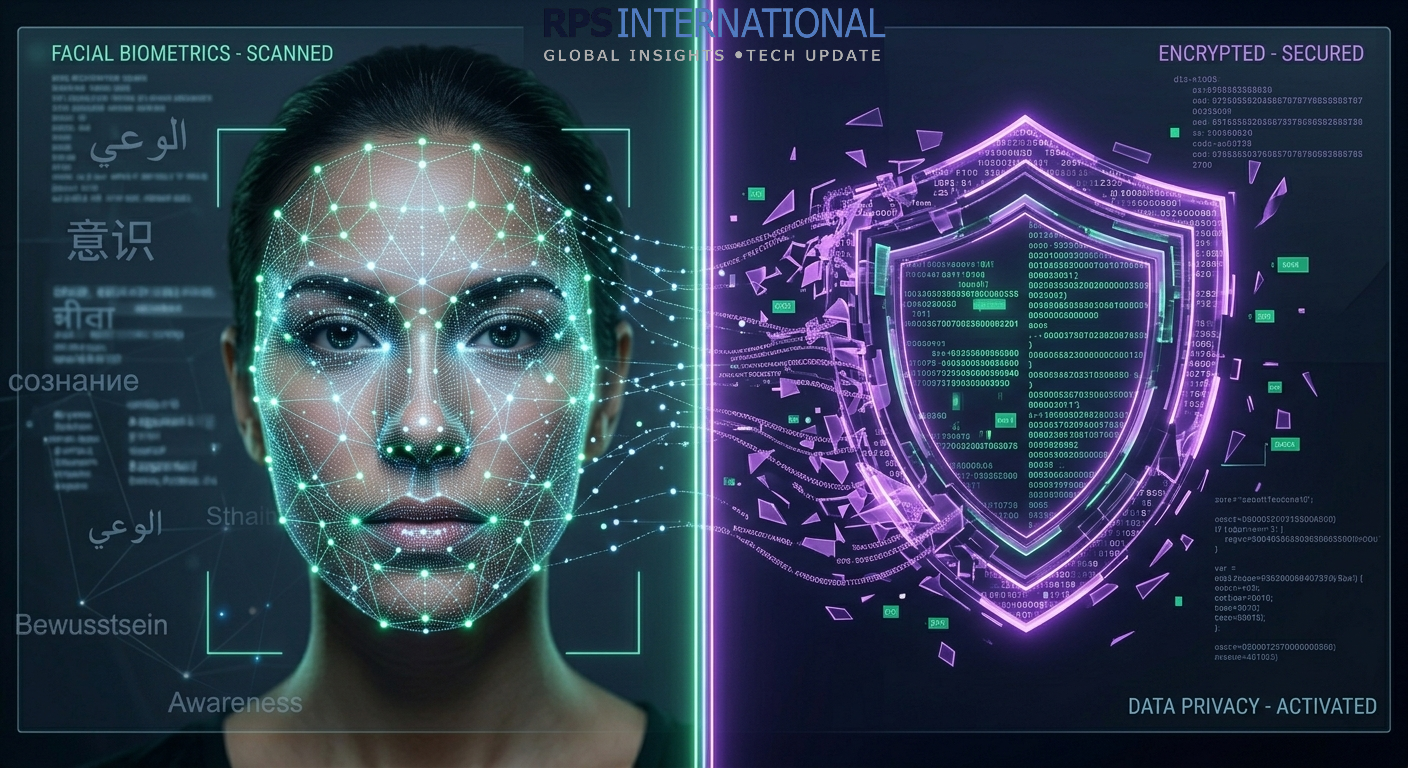
Biometric Authentication:
Security Meets Absolute Privacy
The 2026 Trust Protocols
Liveness Detection 3.0
Using multi-spectral imaging to detect “blood flow” and heat signatures, rendering 2D photos or 3D masks and deepfakes completely ineffective.
Zero-Knowledge Proofs
A method where the system verifies “you are you” without ever actually seeing or storing your raw biometric image on a server.
Behavioral Biometrics
Continuous authentication based on how you type, walk, or hold your phone, providing “silent security” that doesn’t require active scanning.
The “Forever Password” Problem
Unlike a text password, you cannot change your face or your fingerprints. If a biometric database is breached, that data is compromised for life. In 2026, the industry has pivoted to Cancelable Biometrics.
This tech applies a mathematical “distortion” to your biometric template. If a breach occurs, the company simply changes the distortion algorithm, creating a “new” biometric key without you needing a new face.
2026 Policy Insight:
New “Right to Biological Privacy” laws now mandate that all biometric data must be processed at the “Edge” (on your device) rather than in the cloud.
Emerging Bio-Markers
Beyond fingerprints, 2026 sees the rise of harder-to-spoof biological identifiers:
- Vein Pattern Recognition: Mapping the unique vascular structures under your skin.
- Ear Shape Acoustics: Using sound waves to map the unique geometry of the ear canal.
- Heartbeat ECG: Every heart has a unique electrical rhythm that is nearly impossible to replicate.
- Ocular Saltation: Tracking the involuntary microscopic “shivers” of the eye that prove a person is alive.
Decentralization: You Own Your Template
The “Master Key” approach of centralized databases is being replaced by Self-Sovereign Identity (SSI). In this model, your biometric template is stored in a secure enclave on your personal device or a hardware wallet. When a service (like a bank or an airline) needs to verify you, your device performs the check and sends a Verifiable Credential—a digital “yes” or “no”—without ever sharing the actual biometric file.
This puts the user back in control. You can see exactly which apps have requested verification and revoke their access at any time. By decoupling Identification (who you are) from Authentication (proving it’s you), we finally achieve a system where security does not require the sacrifice of personal anonymity.
The Evolution of Bio-Trust
| Feature | Legacy Biometrics (2020) | Privacy-First Biometrics (2026) |
|---|---|---|
| Data Storage | Centralized Cloud Databases | On-Device / Secure Enclave |
| Spoof Protection | Basic Image Matching | AI-Based Liveness Verification |
| User Consent | Implicit / Binary | Granular / Self-Sovereign |
| Encryption | Standard AES/RSA | Cancelable / Homomorphic |
The Future is Passwordless
Secure your organization without compromising user trust. Discover how to implement the 2026 Biometric standard.