
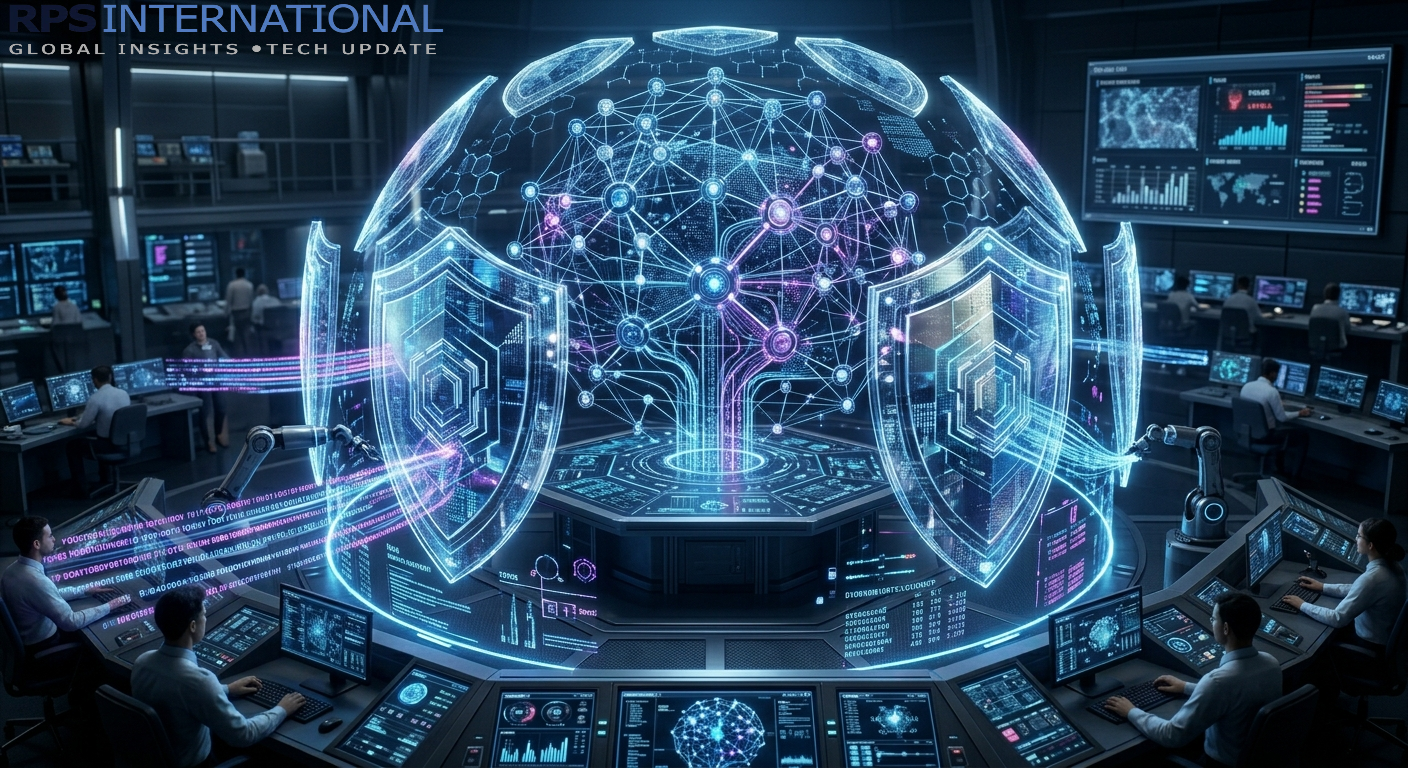
AI-Powered Threat Detection:
Staying Ahead of Cyber Attacks
The 2026 Cyber Shield Blueprint
Cognitive SIEM
Moving beyond simple logs, modern SIEMs use cognitive reasoning to correlate trillions of events, identifying subtle lateral movements that humans would miss.
Autonomous XDR
Extended Detection and Response (XDR) now features autonomous mitigation, instantly isolating infected nodes without waiting for manual approval.
Behavioral Biometrics
AI monitors typing cadence, mouse movements, and access patterns to detect “account takeovers” even when the correct credentials are used.
Defeating the “Zero-Day” Trap
Traditional security relied on “Signatures”—blacklists of known threats. But in 2026, Polymorphic Attacks change their code every few seconds. AI is the only tool fast enough to track these mutations.
By focusing on Anomalous Intent rather than static code, AI-powered systems can identify a Zero-Day exploit by the “ripple effect” it causes within the network’s normal operations.
2026 Benchmark:
Mean Time to Detect (MTTD) has dropped from 28 days to 4.2 minutes for enterprises utilizing unified AI-Security fabric.
Operational Insight: SOC 2.0
The Security Operations Center (SOC) of 2026 is no longer a room of analysts staring at monitors. It is an automated engine where humans handle only the most complex strategy.
- Self-remediated vulnerability patching.
- AI-driven “Threat Hunting” across encrypted traffic.
- Zero-latency Edge security for IoT devices.
- Automated forensic reporting for compliance.
The Rise of Adversarial AI
While AI empowers defenders, it also equips attackers. In 2026, we are witnessing the rise of Adversarial AI—malware that uses machine learning to probe a company’s defenses for weeks, learning the “rhythm” of the security team before launching a strike. This has created a literal “AI vs. AI” battlefield within corporate networks.
To stay ahead, cybersecurity leaders are deploying Deceptive AI. These systems create thousands of “Honey-Tokens” and fake digital assets that look like high-value targets. When an attacking AI interacts with these fakes, the defense AI immediately fingerprints the attacker’s logic and shuts down the real infrastructure to protect it.
Furthermore, the integration of Quantum-Resistant Cryptography within AI frameworks ensures that even the next generation of computing power won’t easily break the encryption layers that the AI is protecting. This multi-layered approach—predictive, deceptive, and resilient—defines the modern standard of cyber hygiene.
Security Evolution: 2021 vs. 2026
| Feature | Legacy Security (2021) | AI-Powered (2026) |
|---|---|---|
| Detection Logic | Rules & Signatures | Behavioral Context & Intent |
| Response Time | Minutes to Hours (Manual) | Milliseconds (Autonomous) |
| Scope | Internal Network Focus | Omni-Channel (Cloud/IoT/Remote) |
| Threat Hunting | Reactive Analysis | Predictive Forensics |
Secure Your Digital Perimeter
The goal isn’t just to stop attacks—it’s to build a network that learns, adapts, and evolves faster than the threats it faces.