
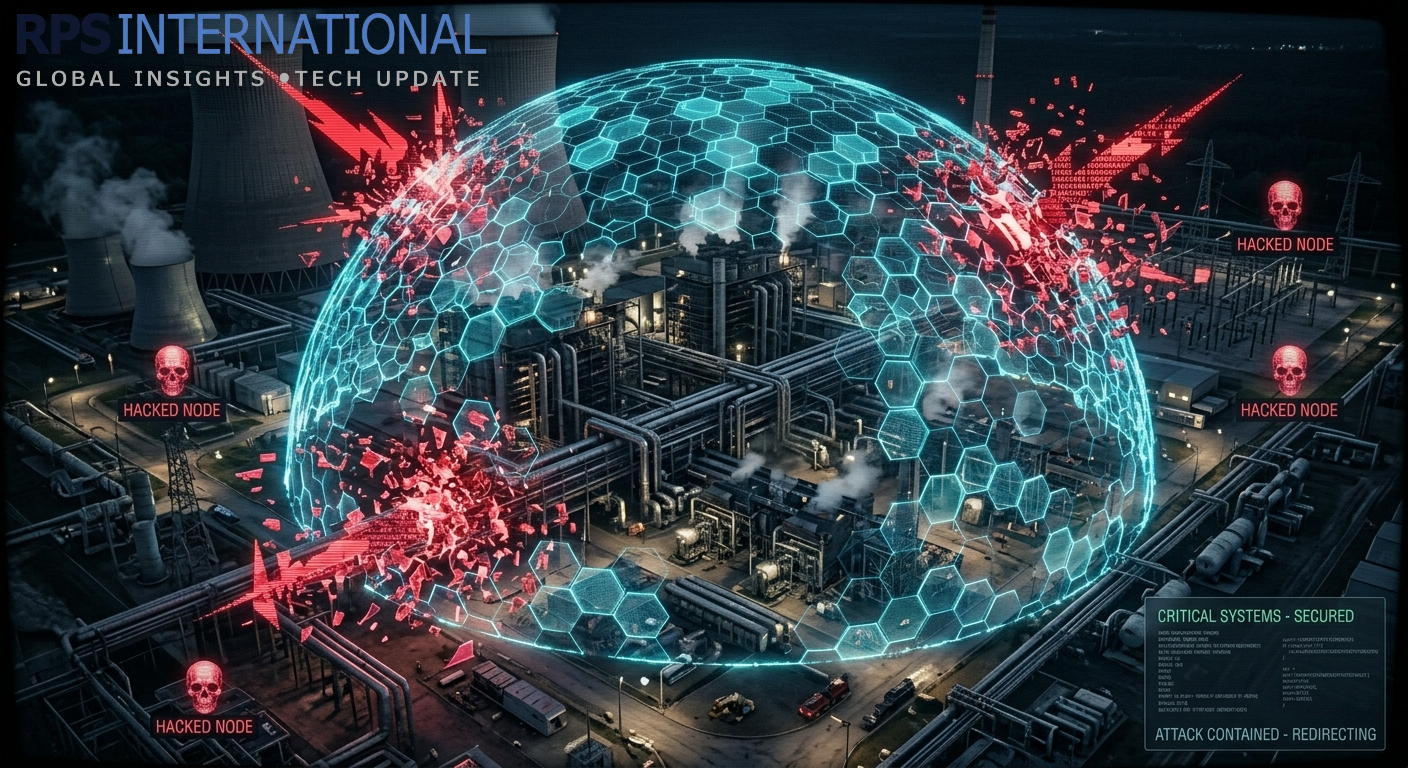
Critical Infrastructure:
The Digital Frontline
Operational Technology (OT) Defense
Logic Integrity Checks
Real-time monitoring of PLC (Programmable Logic Controller) code to ensure that “ghost commands” can’t force hardware to exceed physical safety limits.
Satellite Mesh Recovery
In the event of a terrestrial internet blackout, critical utility nodes switch to dedicated, encrypted satellite links to maintain command and control.
Hardware Attestation
Using silicon-level “Root of Trust” to ensure that every sensor and valve in the field is authentic and hasn’t been tampered with at the factory.
The Rise of Kinetic Cyber Threats
In 2026, hackers don’t just want to steal files; they want to cause Physical Attrition. By manipulating the frequency of a power grid or the chemical balance of a water treatment plant, attackers can destroy equipment that takes years to replace.
To counter this, Digital Twins are now mandatory for all national infrastructure. These virtual models run billions of “What-If” scenarios per second, allowing AI to detect anomalous behavior that human operators would miss.
2026 Readiness Benchmark:
National grids have implemented “Island Mode” capabilities, allowing cities to operate on local micro-grids if the main backbone is compromised.
Infrastructure Defense Layers
How we secure the world’s most vital systems in 2026:
- Unidirectional Gateways: Hardware that physically allows data to flow *out* for monitoring but makes it impossible for signals to flow *in* from the public web.
- Ghost Networks: Hidden, non-IP based communication channels for the most sensitive emergency controls.
- Behavioral Baselining: AI that learns the “sound” and “vibration” of healthy machinery to spot cyber-induced mechanical stress.
- Immutable Change Logs: Using blockchain-inspired ledgers to record every single command sent to the grid for forensic certainty.
The Human-in-the-Loop Requirement
While AI handles the millisecond-level response to cyber-kinetic attacks, 2026 defense doctrine emphasizes Manual Resiliency. Modern control rooms are being retrofitted with “Analog Overrides”—physical buttons and levers that can disconnect a facility from the digital network entirely while maintaining basic operation. This “Back-to-Basics” movement ensures that even if an adversary achieves total digital dominance, they cannot stop the flow of water or heat through a city.
Furthermore, international cooperation has led to the Cyber-Geneva Convention, where major powers agree that certain critical systems—specifically hospitals and nuclear plants—are “Off Limits.” However, as non-state actors and “proxy cartels” grow, the focus remains on Active Threat Hunting, where military cyber-commands proactively disrupt the infrastructure used by attackers before they can launch a strike.
Infrastructure Security: 2020 vs. 2026
| Metric | Legacy OT Security | Modern Kinetic Defense (2026) |
|---|---|---|
| Connectivity | Converged with Corporate IT | Air-Gapped or Unidirectional |
| Detection Mode | Signature-Based (Viruses) | Physics-Based Anomaly Detection |
| Response Speed | Minutes to Hours (Manual) | Micro-Seconds (Autonomous) |
| Failure Goal | Prevent Downtime | Graceful Degradation / Islanding |
Secure the Backbone of Society
The grid is the new frontline. Ensure your utility infrastructure is resilient against the sophisticated threats of 2026.