
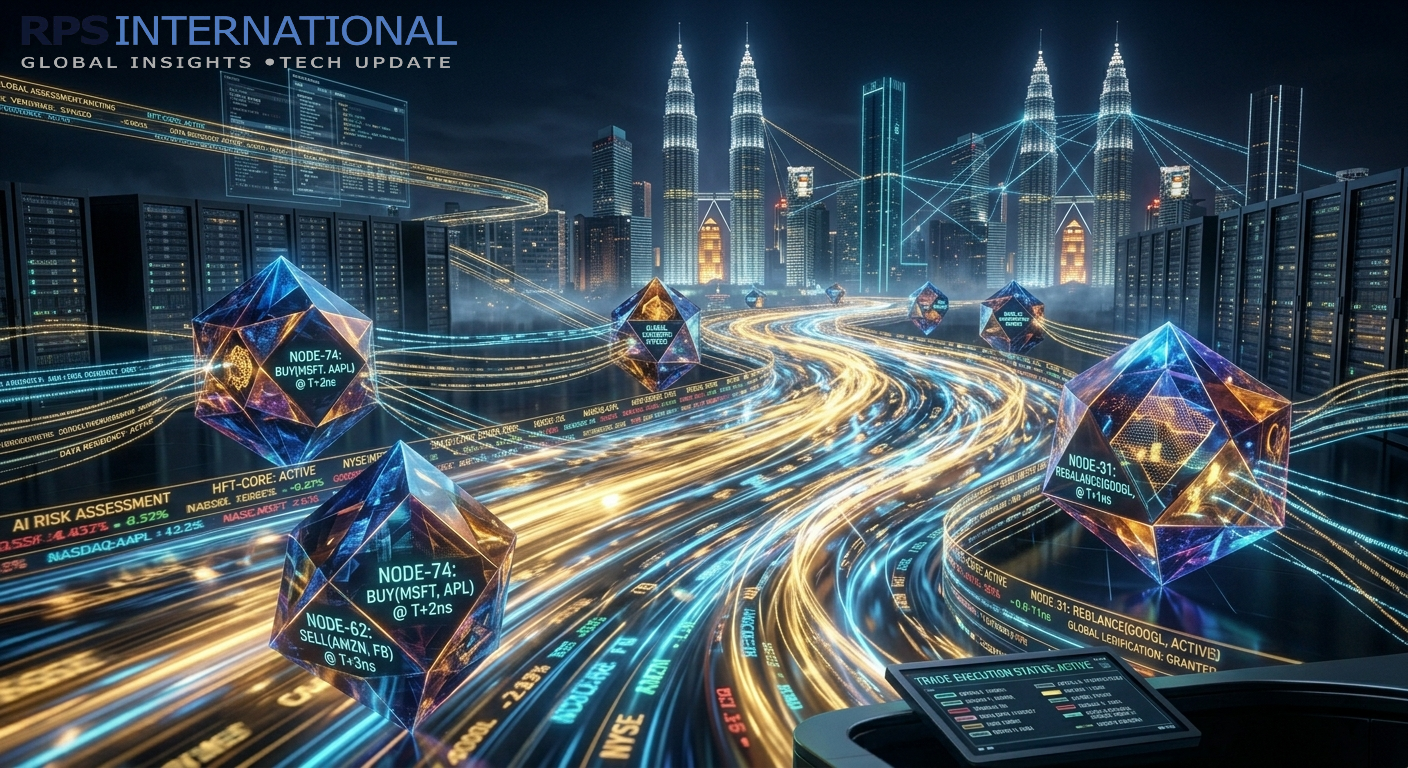
Algorithmic Trading:
The Architecture of High-Frequency Alpha
The 2026 Quant Paradigm
Reinforcement Learning
Algorithms that “play” the market like a game, constantly learning from rewards (profit) and penalties (loss) to optimize entry and exit points autonomously.
Alternative Data Fusion
Integrating non-traditional data—satellite footage of oil tankers, supply chain disruptions, and social media momentum—to predict earnings beats.
Sub-Microsecond Latency
Using custom FPGA chips and laser-based communications to shave nanoseconds off trade executions between global financial hubs.
The Death of Arbitrage?
In 2026, standard price arbitrage has nearly vanished as AI systems across the globe equalize prices in real-time. This has forced quants to look toward Predictive Alpha—using Generative AI to model “What-If” geopolitical scenarios.
If a central bank change is hinted at in a dense 50-page report, LLM-powered agents extract the sentiment and execute the trade in less than 200 milliseconds, long before a human analyst can finish the first paragraph.
2026 Market Stat:
Retail participation in “Algorithmic Mirroring” has grown by 300%, as AI tools allow everyday investors to copy-trade institutional bots.
Market Safety & Guardrails
With machines running the show, the focus has shifted to preventing “Flash Crashes”:
- Dynamic Circuit Breakers: AI-monitored trading pauses that trigger when algorithmic patterns become erratic.
- Kill-Switches: Mandatory “off-ramps” for HFT bots that deviate from their risk-reward parameters.
- Adversarial Testing: Stress-testing algorithms against “Chaos Bots” to ensure they don’t break during black-swan events.
- Audit Trails: Blockchain-based logging of every algorithmic decision to ensure market fairness.
The Algorithmic Shift: 2020 vs. 2026
| Feature | Legacy Algo Trading | Modern AI Trading (2026) |
|---|---|---|
| Data Input | Structured Pricing Data | Multi-Modal (Video, Text, SAT-Data) |
| Strategy Logic | Hard-coded (If/Then) | Evolving (Neural Reasoning) |
| Execution Goal | Speed (Low Latency) | Insight (High Probability) |
| Risk Control | Manual Thresholds | Autonomous Risk Hedging |
Master the Modern Market
Stay ahead of the bots. Learn how to leverage the latest AI trading frameworks to enhance your portfolio’s performance in 2026.