
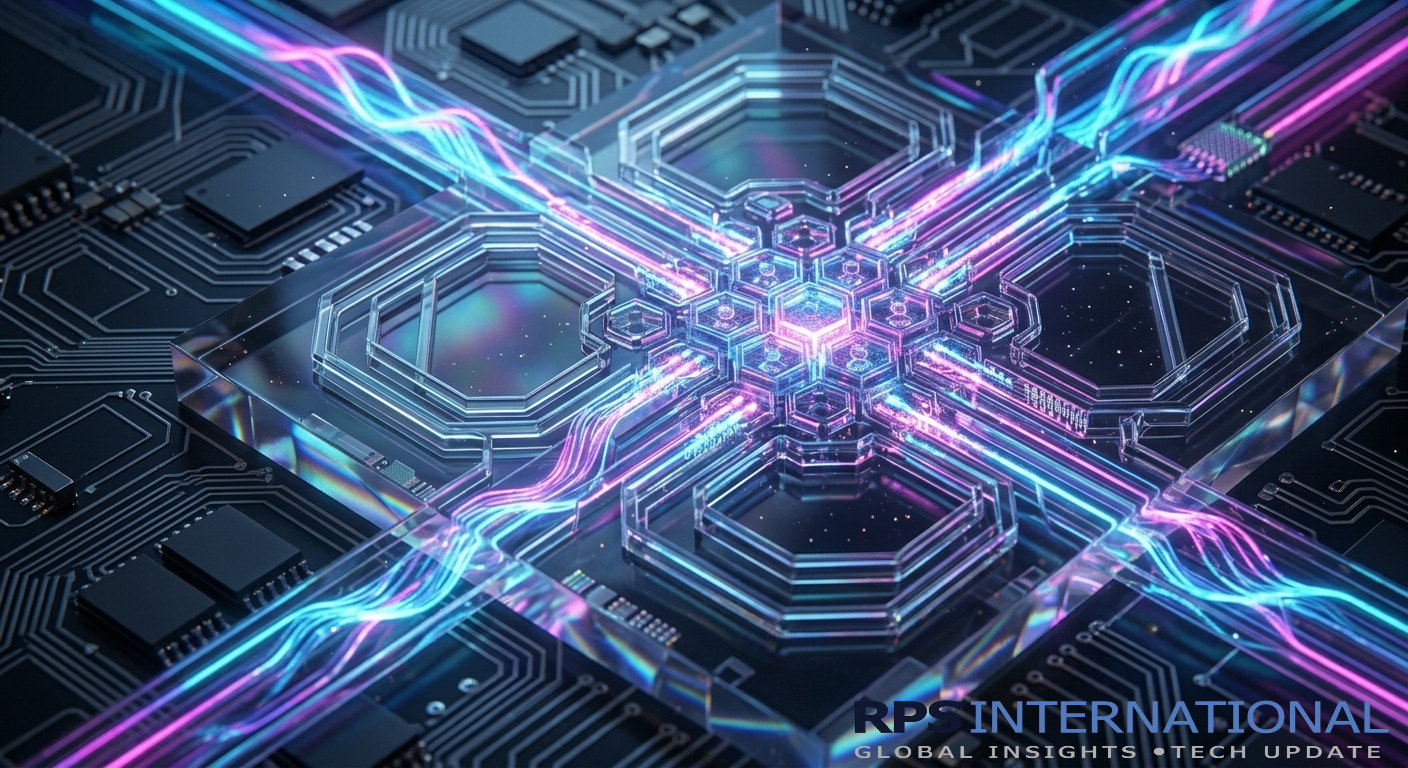
Photonic Computing:
Computing at the Speed of Light
The 2026 Photonic Arsenal
Silicon Photonics
Integrating laser-based communication directly into silicon wafers, allowing chips to “talk” to each other at terabit speeds without generating heat.
Optical Neural Networks
Processing AI matrix multiplications using light interference patterns, completing calculations in picoseconds with negligible power consumption.
WDM Multiplexing
Wavelength Division Multiplexing allows hundreds of data streams to travel through the same optical path by using different colors of light.
Why Electricity is Slowing Down
As we shrink transistors, the copper wires connecting them act like heaters. In high-performance AI data centers, more energy is often spent cooling the chips than actually powering the logic. This is the “Interconnect Bottleneck.”
Photons have no mass and no charge. They don’t interact with each other and don’t create resistance when moving through silicon waveguides. This allows for Zero-Heat Communication at the chip level.
2026 Industry Impact:
Hyperscale data centers are now seeing a 40% reduction in PUE (Power Usage Effectiveness) by switching to optical-based server racks.
The “Light” Advantage
Photonic computing offers three physical advantages that electronic chips simply cannot match:
- Parallelism: You can send many wavelengths (colors) of light through one “wire” simultaneously without interference.
- Latency: Data travels at the speed of light in silicon, which is roughly 30% the speed of light in a vacuum—drastically faster than electrical signals.
- Energy Density: A single optical signal can carry more information than a bulky bundle of copper cables.
- Passive Math: Optical components like lenses and gratings can perform complex mathematical transforms instantly as light passes through them.
Fueling the AI Renaissance
In 2026, the bottleneck for AI isn’t the raw power of the processor; it’s the speed at which data moves between the memory (HBM) and the compute cores. Optical Interconnects have finally solved this. By replacing electrical pins with micro-lasers, we can achieve “all-to-all” connectivity between thousands of GPUs, making an entire data center behave like one giant, unified processor.
Furthermore, we are seeing the rise of Photonic Tensor Accelerators. These chips are designed specifically for the linear algebra that powers Deep Learning. Unlike digital chips that must switch transistors on and off billions of times per second, photonic accelerators use the natural wave properties of light to perform calculations. This is “Analog Computing” reborn for the modern age, capable of running models with trillions of parameters while using a fraction of the electricity.
Electronics vs. Photonics: 2026 Benchmark
| Metric | Legacy Electronic Chip | Next-Gen Photonic Chip |
|---|---|---|
| Data Carrier | Electrons (Mass/Charge) | Photons (Massless) |
| Data Bandwidth | Limited by Resistance | High (Multi-Wavelength) |
| Thermal Output | High (Joule Heating) | Near-Zero |
| Ideal Use Case | General Purpose Logic | AI Training / Cloud Data |
Light Up Your Data Strategy
The limit of silicon is here. The era of light has begun. Explore how photonic computing will redefine the next decade of infrastructure.