
THE LAST
HUMAN VETO
The 2026 Regulatory Challenges
The “Black Box” Liability
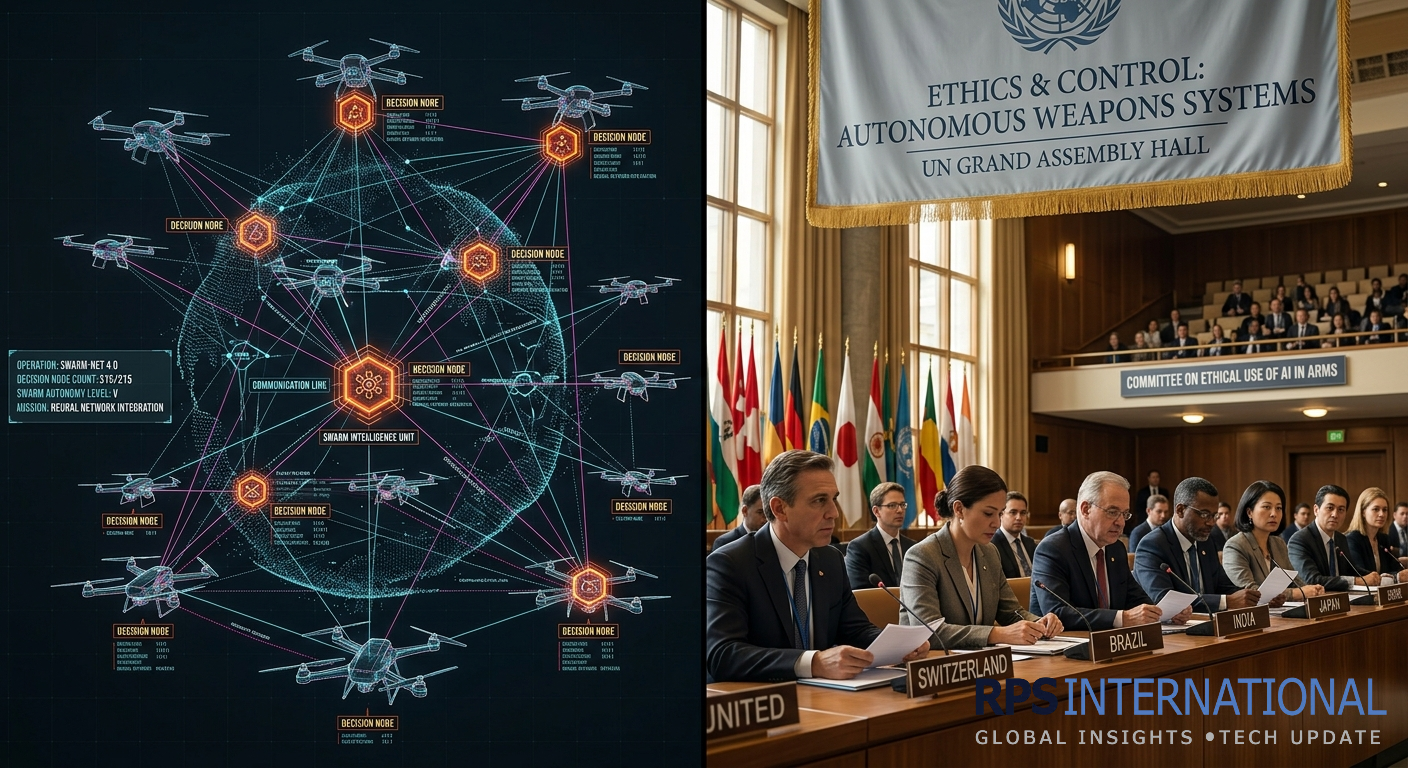
In 2026, the primary legal hurdle is ‘Traceable Accountability’. When an AI-driven swarm makes a targeting error, who is responsible? Current international law requires a human intent to prove a war crime. Without a ‘Human Veto’ at the point of engagement, the 2026 report warns of a total collapse in military accountability frameworks.
Dual-Use Escalation
The 2026 arms race is fueled by ‘Dual-Use’ technology. Commercial drones and open-source AI models are being converted into ‘Loitering Munitions’ at a fraction of the cost of traditional missiles. This democratization of lethality makes verification nearly impossible, as the difference between a delivery drone and a killer robot is often just a software patch.
“Machines do not understand human dignity, nor can they appreciate the gravity of taking a life. In 2026, we are at a crossroads: either we establish a firm ‘Human-in-the-Loop’ mandate, or we risk a world where wars are fought by algorithms and the victims are left without a name or a responsible party. The 2026 treaty is our final chance to keep war within the bounds of human ethics.”
— Julian Vane, International Arms Control Advisor 2026
Defend the Human Veto.
How will the 2026 LAWS treaty impact global security? Access the full GGE Geneva Report: The Future of Autonomous Arms Control.